
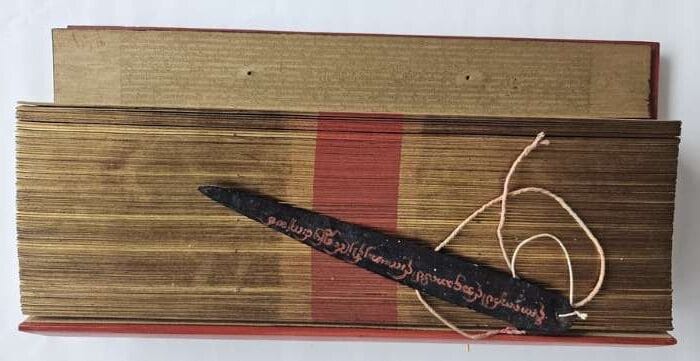
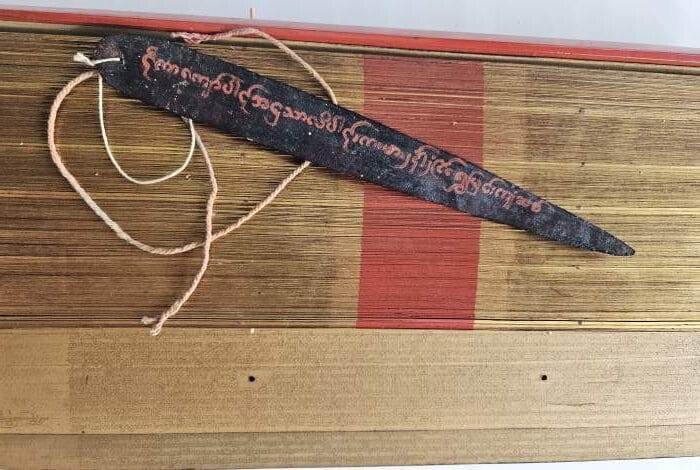
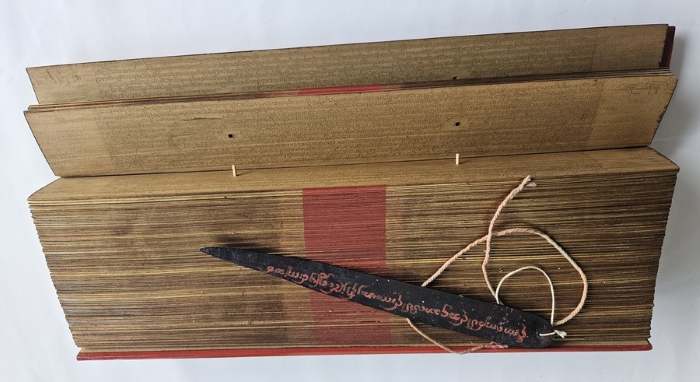
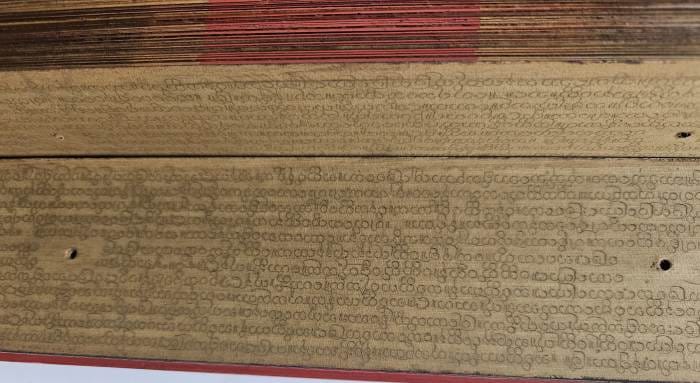
Antique Burmese Palm Leaf Buddhist Manuscript
The Paysa (or Pe-sa) is far more than a book; it is a sacred vessel of Theravada Buddhist tradition. For centuries, these palm-leaf manuscripts were the primary medium for preserving the Tipitaka (Buddhist scriptures), local chronicles, and esoteric medicinal texts in Myanmar.
Palm‑leaf manuscripts of this type commonly contain Buddhist scriptures, commentaries, Paritta chants, or monastic teachings, and were traditionally produced in monastic scriptoria or commissioned as acts of merit.
The purpose of the wooden outer covers is both practical and ritual: they shield the fragile palm leaves from humidity and insects while signifying the sacred status of the text.
The Meaning & Significance of Paysa
The term “Paysa” literally translates to “palm-leaf writing.” In the Burmese tradition, the creation of a manuscript was considered an act of supreme merit (kutho).
- Sacred Geometry: The physical format of the Paysa—long, narrow, and bound between decorative wooden covers—reflects the monastic discipline of the Sangha. The horizontal orientation is symbolic of the “steady path” toward enlightenment.
- The Medium of the Dhamma: For a monk or a layperson, commissioning or gifting a Paysa was a way to “sustain the Sasana” (the religion). It was believed that as long as the Dhamma was preserved on these leaves, the light of the Buddha would not fade from the world.
The Craftsmanship: From Leaf to Library
The “use” of a Paysa began with a complex, months-long preparation process that turned an organic leaf into a medium that could survive for centuries in the tropical heat.
- Preparation of the Pe-leaf
- The leaves of the Corypha umbraculifera (Talipot palm) were harvested, boiled in water or milk to remove natural sugars, and then dried and pressed. This made the leaf flexible, durable, and resistant to insects.
- The Art of the Stylus (Kanyit)
- Unlike Western parchment, Paysa were not written with ink on the surface. Instead, a sharp iron stylus called a kanyit was used to incise the delicate Burmese script into the fibers of the leaf
- The “Inking” Process: Once the text was incised, a mixture of soot (lampblack) and earth oil (crude petroleum) was rubbed over the leaf. The oil protected the leaf, while the soot settled into the scratches, making the elegant, circular Burmese script appear.
- Binding and Protection (Kyan) The leaves were stacked and held together by two wooden boards called kyan. In royal or high-ranking monastic versions, these boards were heavily lacquered in red (cinnabar) and adorned with intricate gold leaf (shwe zawa) or encrusted with glass mosaic (hman-zi-shwe-cha).
The Functional Use of Paysa
Monastic Education
The Paysa is the “textbook” of the monastery. Novices and monks would use them to memorize Pali verses. Because of their portability, they could be carried easily between forest monasteries and city centers.
Ritual and Recitation
During important Buddhist ceremonies, monks read from the Paysa. The physical act of unbinding the manuscript and sliding the leaves across one another is a rhythmic, ritualistic process that accompanies the chanting of the Paritta (protection suttas).
Secular Records
While the majority of Paysa are religious, they were also used for:
- Astrology & Horoscopes: (Zata) Many Burmese individuals had their birth details recorded on a single, small palm leaf.
- Indigenous Medicine: Formularies for traditional healing and alchemy were often recorded on “secular” Paysa to be passed down through lineages of healers.

