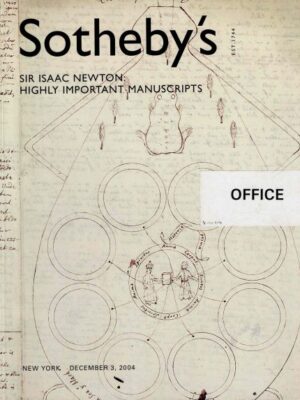


Sotheby’s Sir Isaac Newton – Important Manuscripts
On July 13 and 14, 1936, the London auction house Sotheby’s held a landmark sale that fundamentally altered the public’s understanding of Sir Isaac Newton. For over two centuries, the Portsmouth family had held Newton’s private writings. While they donated his purely scientific and mathematical works to Cambridge University in 1872, they retained his extensive research into alchemy, biblical prophecy, and ancient world history.
On July 13 and 14, 1936, the London auction house Sotheby’s held a landmark sale that fundamentally altered the public’s understanding of Sir Isaac Newton. For over two centuries, the Portsmouth family had held Newton’s private writings. While they donated his purely scientific and mathematical works to Cambridge University in 1872, they retained his extensive research into alchemy, biblical prophecy, and ancient world history.
The economist John Maynard Keynes and the scholar Abraham Yahuda were the primary figures who recognized the collection’s immense value. Keynes eventually reassembled nearly half of the dispersed papers, famously concluding that Newton was “not the first of the age of reason” but rather “the last of the magicians.” Their efforts preserved the bulk of this research, which today resides in King’s College, Cambridge, and the National Library of Israel.