


Chinese Characteristics by Arthur H. Smith
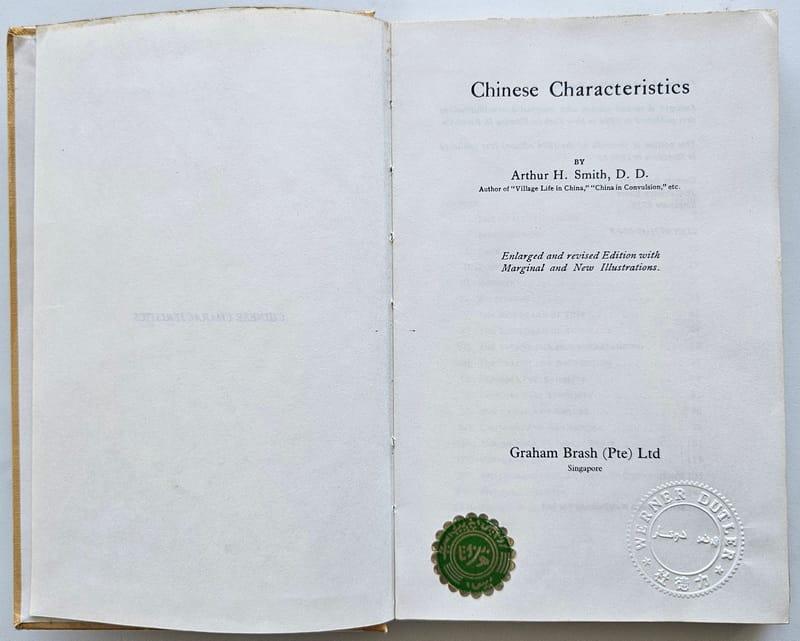
Chinese Characteristics by Arthur H Smith D.D.
A Foundational Work of 19th-Century Ethnography and Cross-Cultural Observation
First published in 1890, Chinese Characteristics remains one of the most cited and debated works in the history of Western Sinology. Written by Arthur H. Smith, a missionary who spent over fifty years in China, this volume presents a complex, often provocative “anatomy” of Chinese society during the twilight of the Qing Dynasty.
Key Themes:
- Social and Family Structure: Smith provides a granular look at the Confucian ideals that governed daily life, from the importance of “Face” to the rigid hierarchies of the ancestral village.
- Pragmatism and Patience: The book famously categorizes the Chinese character through traits such as “The Absence of Public Spirit,” “The Talent for Misunderstanding,” and “The Contentment with Environment.”
- Bureaucracy and Education: Detailed observations on the Imperial examination system and the intricate, often baffling workings of local and provincial governance.
- Anecdotal Mastery: Blending sharp-witted anecdotes with sweeping sociological generalizations, Smith captures the sights, sounds, and social pressures of a China caught between ancient tradition and the pressures of Western encroachment.
A Collector’s and Scholar’s Essential:
While Smith’s writing is undeniably shaped by the colonial biases of the late Victorian era, its impact is undeniable. It served as the primary textbook for Westerners entering China for a generation and remains a vital primary source for understanding the evolution of ethnographic thought. This edition, preserving the original text and illustrations, is an indispensable artifact for those interested in missionary literature, the history of the Great Game, and the complex roots of East-West relations.
“A compelling, sometimes startling window into a vanished world. Smith’s observations are essential reading for anyone seeking to understand how the West first attempted to ‘read’ the soul of China.”